Skip to content Skip to content
NEXOR DAUGHTERBOARD · SENSOR

Aeris Pressure, humidity and temperature sensor module

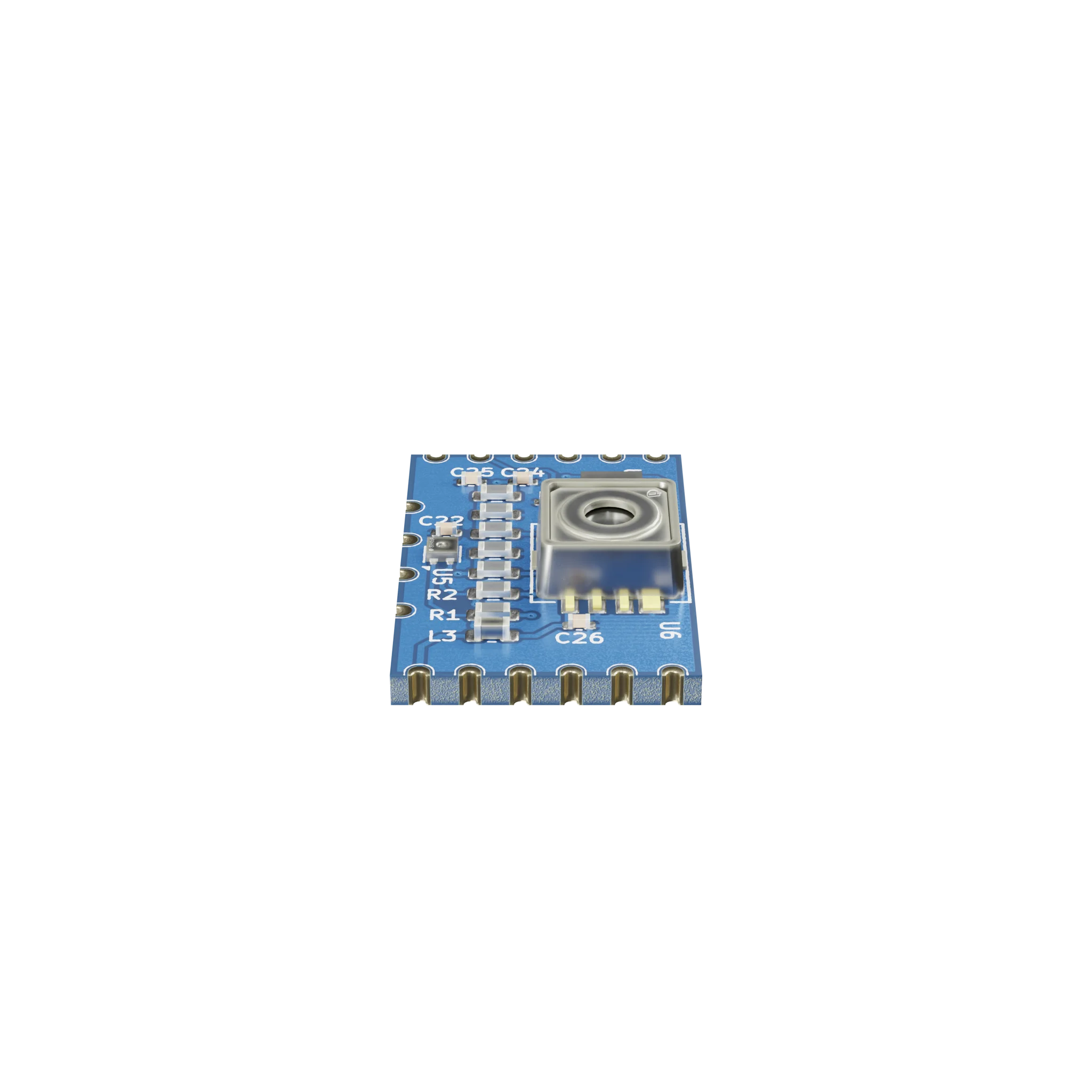
Aeris is the PHT (pressure-humidity-temperature) daughterboard for the Nexor carrier. It combines a MEMS absolute-pressure sensor and a digital humidity-and-temperature sensor on a single compact board that solders directly onto one face of the carrier through castellated pads. The carrier supplies power and reads all three measurements, publishing them on the CAN bus: Aeris needs no supply or wiring of its own.

Solders onto the Nexor carrier: power, processing and CAN are already on board. Discover the platform

OVERVIEW

Turns Nexor into an environmental sensor

Both sensing elements are individually factory-calibrated and the board is built with automotive-grade, RoHS-compliant components. It operates from -40°C up to +125°C, and the humidity sensor stays fully functional in condensing conditions thanks to an integrated heater that the carrier pulses to clear condensation from the sensor surface. The on-board memory lets the Nexor carrier recognise Aeris automatically and apply the matching calibration. Where the same measurement is needed as a standalone node, without a carrier, the Pressor sensor covers it.

ORDER CODE · NXL-AERIS-10A REVISION · 1.0a (preliminary)
01 / Sensing

What it measures

Three factory-calibrated channels, published on the CAN bus by the carrier

Absolute pressure
15 - 400 kPa
Accuracy
±3.8 kPa typ.
Resolution
0.12 kPa
Response (t63)
5 ms
Relative humidity
0 - 100 %RH
Accuracy
±2 %RH typ.
Resolution
0.01 %RH
Response (t63)
4 s
Temperature
-40 - +125 °C
Accuracy
±0.2 °C typ.
Resolution
0.01 °C
Response (t63)
2 s
02 / Integration

How it works with Nexor

Role split: the module conditions, the carrier digitises and publishes

Aeris Sensor

Conditions the signals and carries the sensing elements

Nexor CARRIER

Powers, digitises, calibrates and publishes on CAN

Resources used on the carrier face
Pressure signal Analog input (ADC) Conditioned analog voltage proportional to absolute pressure
Humidity & temperature Sensor I2C bus Digital humidity and temperature readout with CRC
Board identification Shared ID bus Identification and calibration memory, address set by the mounting face
Power +5 V, +3.3 V, GND Entirely supplied by the carrier, no external supply
03 / Features

Key Features

What makes this module unique

Pressure, humidity and temperature on a single 21 x 14 mm board

Extended operating range from -40°C to +125°C

Condensation-proof, with integrated anti-condensation heater

Factory calibration on each individual sensing element

Automotive-grade AEC-Q100 components, RoHS and REACH compliant

Automatic detection on the carrier via identification memory

04 / Specifications

Technical Specifications

01 · SENSING
Absolute pressure
15 - 400 kPa (±3.8 kPa typ.)
Relative humidity
0 - 100 %RH (±2 %RH typ.)
Temperature
-40 / +125 °C (±0.2 °C typ.)
Long-term stability
< 0.2 %RH/year · < 0.03 °C/year
02 · ELECTRICAL
Supply
From carrier: +5 V / +3.3 V
Current draw
8 - 10 mA (heater excluded)
Anti-condensation heater
35 mA max, duty cycle ≤ 10%
ESD
≥ 2 kV HBM on the fitted components
03 · PHYSICAL
Dimensions
21 x 14 mm, 2-layer PCB
Mounting
16 castellated pads, 2.27 / 3.30 mm pitch
Overpressure
600 kPa max (≤ 300 s)
Qualification
AEC-Q100 · RoHS · REACH
05 / Applications

Applications

Where it's used

  1. 01 HVAC

    Climate monitoring for buildings, ducts and cabinets

  2. 02 Industrial

    Process control and monitoring of enclosures and machinery

  3. 03 Barometric

    Weather, altitude and atmospheric pressure sensing

  4. 04 Engine bay

    High-temperature environments up to +125°C

  5. 05 Condensation

    Humid and condensing environments, with heater recovery

  6. 06 Dual-sensor

    Two-function CAN node with a second daughterboard

06 / Gallery

Gallery

07 / FAQ

Aeris: Our Customers' Questions

Does Aeris keep working in condensing conditions?
The Aeris humidity sensor stays fully functional in condensing environments: condensed water does not harm it, it only makes the reading unresponsive to the air until the surface is dry again. An integrated heater, activated on demand by the carrier in short pulses (10% maximum duty cycle), clears condensed or sprayed water from the sensor surface and counteracts drift in persistently humid conditions.
How does Aeris connect to the Nexor carrier?
Aeris has no connectors or wiring: it solders onto one face of the Nexor carrier through 16 castellated pads (two side columns of 6 at 2.27 mm pitch and a bottom row of 4 at 3.30 mm), using standard lead-free reflow soldering (IPC/JEDEC J-STD-020). All power and signals pass through the pads, and the board is mechanically supported by the solder joints alone.
Does Aeris need dedicated firmware?
Aeris runs no firmware of its own: the Nexor carrier samples the three channels, applies the calibration stored on the board and publishes the results on the CAN bus. At power-up the carrier automatically recognises Aeris through its identification memory and loads the correct configuration, even with two Aeris boards fitted on the two faces.
Is Aeris suitable for harsh environments like an engine bay?
Aeris is built throughout with automotive-grade AEC-Q100 components and operates from -40°C to +125°C, so it withstands an engine bay given proper mechanical protection. The sensor openings are not sealed, though: in dusty, wet or splash-prone installations, fit the node in an enclosure with a vented, water-repellent membrane that lets the measured air reach the sensors while keeping out liquids and particulates.
GET IN TOUCH

Ready to integrate Aeris?

Need Aeris on your Nexor carrier? Write to us, we reply within 1-2 business days.

Contact Us
