
Two independent faces: up to two functions on the same CAN node
CARRIER PLATFORM
NEXOR Modular carrier platform to read sensors and interfaces over CAN
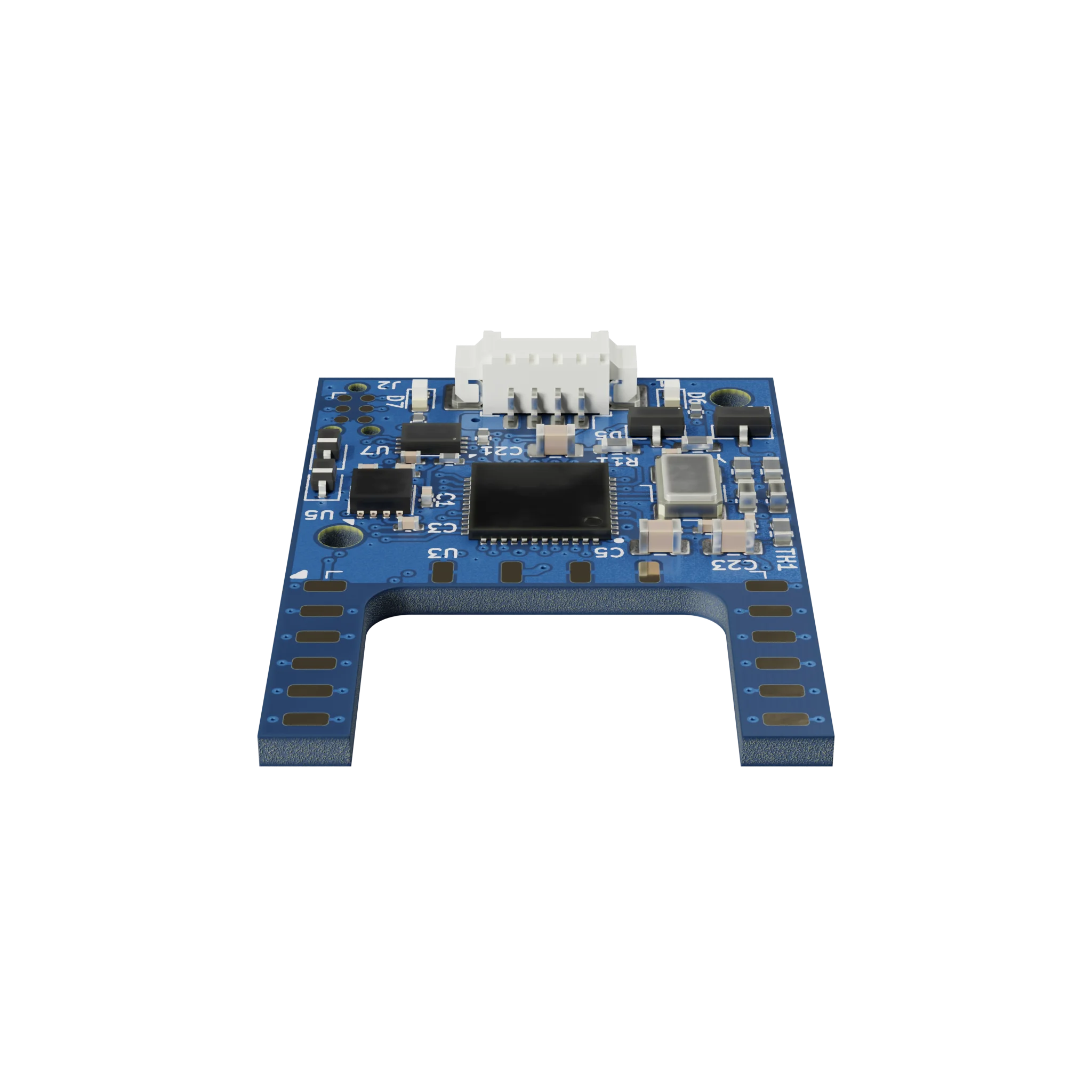
The common core of the Nexilica CAN module line: a field-ready CAN FD node with a protected 9-28 V input and a single connection for both supply and bus. The fitted module sets the function – a sensor like Aeris, a converter like Bliss – up to two per node.
OVERVIEW
The common core of Nexilica devices
Nexor is the carrier board that acts as the common core of the Nexilica CAN module line: it concentrates power, processing and the CAN bus into a single reusable module, and leaves both faces free for a daughterboard. Each function – a sensor like Aeris, a converter like Bliss – is a specialized board mounted on one face of the carrier: by changing only that board, an entire product line is obtained while power, processing and communication stay unchanged.
The node runs from a 9-28 V DC input protected against reverse polarity and transients, and powers the fitted daughterboards from it: a single connector carries both supply and CAN, with no separate sensor supply. At power-up Nexor detects which board is mounted on each face and loads its calibration, even when the two boards are identical, and keeps its own supply voltage and temperature under watch for diagnostics.
01 / Ecosystem
One platform, an entire line
The daughterboard measures or converts – Nexor powers, identifies, calibrates and publishes on CAN
DAUGHTER BOARDS
Aeris Sensor AVAILABLE
Pressure, humidity and temperature sensor module
PressureHumidityTemperature
Discover the module Bliss Interface AVAILABLE
SSI interface for absolute encoders and sensors
SSIRS-422Encoder
Discover the module Your module
Need a measurement or an interface on the CAN bus? We develop custom daughterboards on the pre-validated Nexor core.
Let’s talk 02 / Features
Key Features
The core shared by the entire module line
CAN FD system bus: 1 Mbit/s classic, 5 Mbit/s data rate
Automatic detection of the fitted module, with its calibration
A single connection for supply and CAN, powering the fitted daughterboards too
9-28 V DC supply, reverse-polarity and transient protected
-40/+125 °C operating range with built-in diagnostics
03 / Advantages
Advantages
01
One platform, a whole line
only the daughterboard changes, while power supply, processing core and CAN bus stay identical across the entire sensor family
02
Automatic detection
at power-up the carrier identifies the fitted module and loads its correct configuration and calibration, even with two identical boards fitted
03
Field-ready
supply input protected against reverse polarity and transients, -40/+125°C operating range and built-in voltage and temperature diagnostics
04
Faster time-to-market
a new sensor only needs a new daughterboard, developed on a pre-validated core with existing power, CAN and firmware
04 / Specifications
Technical Specifications
01 · COMMUNICATION
CAN bus
ISO 11898-2 · classic + FD
Bit rate
1 Mbit/s classic · 5 Mbit/s FD
Transceiver
5 V, compatible with high-speed nodes
02 · NODE
Daughterboards
Up to 2, one per face
Recognition
Automatic, with the module calibration
Module supply
From the carrier, no separate source
Diagnostics
On-board voltage and temperature
03 · POWER · PHYSICAL
Supply
9-28 V DC (24 V nom.), protected
VDD withstand
±33 V, absolute maximum
Current draw
20-35 mA (carrier only)
Temperature
-40 / +125 °C
Dimensions
25 x 35 mm · 2x M2 holes
PINOUT · CONNECTIONS
J1 Molex PicoBlade 4-pin · 53261-0471
PIN · Blue
CAN1_L (CAN low)
PIN · White
CAN1_H (CAN high)
PIN · Black
GND (Ground)
PIN · Red
VDD 9-28 V (24 V nom.)
05 / Applications
Applications
Platform scenarios
- 01 Line core
Common core for a modular line of CAN sensors and converters
- 02 Dual-function
Dual-function nodes with two daughterboards on one carrier
- 03 CAN FD backbone
Distributed sensing and actuation on a CAN FD backbone
- 04 Field ID
Field-identifiable and field-calibrated endpoints
- 05 Dev platform
Development platform to prototype new modules on a validated core
06 / FAQ
Nexor: Our Customers' Questions
Does Nexor work on its own, without a daughterboard?
Nexor is a platform, not a finished product: on its own it provides power, processing and CAN communication, but no application function. Functions come from the specialized daughterboard fitted on one or both faces of the carrier: a sensor like Aeris or a converter like Bliss. The bare carrier draws 20-35 mA and still acts as a diagnosable CAN node, monitoring its own supply voltage and temperature.
Can I mount two sensors on the same Nexor?
Yes: the carrier takes one daughterboard per face, so up to two functions on the same node. Fitting two different boards builds a node that exposes two measurements over a single CAN connection, with one supply and one address on the bus. Nexor tells the two boards apart even when they are identical, because identification follows the face they are mounted on.
How does Nexor detect which daughterboard is mounted?
Each daughterboard carries its own identification and calibration data on board. At power-up Nexor reads it, detects which board is fitted on each face and automatically configures the matching functions, loading that specific board's calibration: no jumpers, no manual configuration, no firmware rebuild when a module is swapped.
What supply and CAN bus does Nexor support?
Nexor accepts a single 9-28 V DC input (24 V nominal) protected against reverse polarity and fast transients, and also powers the mounted daughterboards: no separate supplies are needed. The CAN bus is ISO 11898-2 compliant and supports both classic CAN up to 1 Mbit/s and CAN FD up to 5 Mbit/s, with a 5 V transceiver compatible with other high-speed nodes on the same bus.
Explore more
Related services and products for this solution
GET IN TOUCH
Ready to build on Nexor?
Whether you need a standard module or a custom daughterboard, we reply within 1-2 business days.
Contact Us